Resistor Power Rating
Power Rating
In addition to amount of resistance, resistors have another important characteristic that describes them: power rating.
When power flows through a resistor, some of the energy is converted into heat. The amount of heat a resistor can safely dissipate is characterized by its power rating, and is specified in wattage.
Most common resistors have a power rating between 1/8 watt (0.125W) and 1 watt. Resistors with higher power ratings are usually referred to as power resistors, and used specifically to dissipate power.
Power Calculation when only Voltage or Amperage and Resistance is Known
On the last page, we learned how to calculate the amount of power (in wattage) that passes through a resistor circuit by first using Ohm's law to calculate both voltage and amperage, and then calculate the power from that. However, we can use a couple of power calculation laws to calculate power if we only know amperage and resistance, or voltage and resistance.
Power Calculation when Amperage and Resistance is Known
Recall that the definition of the watt is amps * volts, and I is historically used to stand in for amps, and P means (p)ower in wattage, so we can state:
Power = I(in amps) * Voltage
 - or -
P = I * V
And Ohm's law, solved for voltage, is:
V = I * R
We can substitute Ohm's law (I * R for V), into the watt/power definition:
P = I * (I * R) = I^2 * R
Therefore, if we know amperage and resistance, we can calculate power in a circuit as:
P = I^2 * R
Power Calculation when Voltage and Resistance is Known:
We can also solve for power if we only know voltage and resistance.
Starting with Ohm's law, solved for amperage:
I = V / R
We can substitute that into the watt definition
P = Watts = V * I = V * (V / R) = V^2 / R
Therefore, if we know voltage and resistance, we can calculate power in a circuit as:
P = V^2 / R
Power Rating Practice Problems
Recalling the simple resistant circuit:
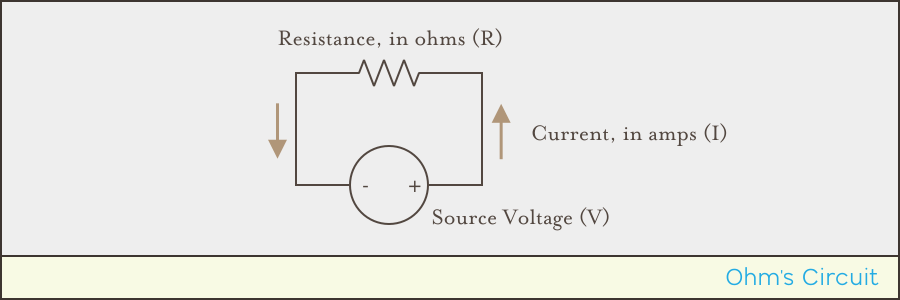
And our power calculation shortcuts:
P = I^2 * R
P = V^2 / R
Let's walk through some sample problems:
1) If the current is 100mA, and the resistance is 20Ω, what power rating must the resistor have?
P = 0.100A ^2 * 20Ω = 0.2W
The nearest power rating to 0.2 would usually be a 1/4 watt.
2) If the source voltage is 5V, and the resistance is 100Ω, what minimum power rating must the resistor have?
P = 5^2 / 100Ω = 0.25W = 1/4 watt.
We can test this by doing the long-hand calculation. First, let's use Ohm's law to solve for current/amperage:
Given:
I = V / R

Therefore:
I = 5V / 100Ω = 0.05A
And then solving for power:
P = 5V * 0.05A = 0.25W = 1/4 watt